

California cities are fighting back against a federal offshore drilling proposal
Jackie Krentzman is a Bay Area-based writer and editor.
For Eric Friedman, the ocean and beach are the sources of his most important memories. He caught his first wave surfing at Refugio Beach. He met his wife while paddleboarding. And like many Santa Barbara natives, Friedman learned about a 1969 oil spill that dumped four million gallons of oil off the city’s coastline.

But it wasn’t until 2015 that he saw the impact of spills firsthand, when a corroded pipeline leached 150,000 gallons of oil into the bay. “The oil from this Refugio spill drifted all the way down to Ventura County, and I remember reports saying that they even found traces of that oil down in Los Angeles County by Long Beach,” says Friedman, now a Santa Barbara city council member.
The Refugio incident became one of the worst oil spills in state history. Today, the federal government wants to restart oil production near Refugio — and up and down California’s coast. And city officials are fighting back.
The disaster that helped launch the EPA
For many advocates, this fight goes back decades. In 1969, a Union Oil platform off the Santa Barbara coast became the site of what was then the largest oil spill in U.S. history. (The Deepwater Horizon spill claimed that title in 2010.) The blowout spread more than three million gallons of oil over the 11 days, across hundreds of square miles of coast, and killed over 10,000 seabirds, dolphins, seals, and sea lions.
“Offshore drilling poses many, many hazards,” says Richard Charter, the founder of the Local Government OCS Coordination Program, a group of local agencies banding together to protect California’s coast from the adverse impacts of offshore drilling.
“[Even] if nothing goes wrong, an oil rig off your coast can be the largest source of air quality pollution in your area, as onshore winds can bring the chemicals to the coast. In addition, spent drilling materials that contain lead, mercury [and] cadmium get discharged into the ocean. And if something does go wrong — like a pipeline breaking and a spill coming ashore, or worst of all, a blowout — the oil can reach shore in half an hour.”
In many ways, the Santa Barbara disaster helped launch the modern environmental movement. It inspired Earth Day and the creation of the U.S. Environmental Protection Agency, and major state and federal safeguards, including the California Environmental Quality Act. Later oil spills strengthened bipartisan opposition at the state and federal levels to offshore drilling.

“The citizens of California and the local governments here were convinced by the federal government and the oil industry that nothing could ever go wrong,” says Charter. “But then, after the spill, President Richard Nixon came out here with his Secretary of the Interior and walked around in their shiny shoes on the beach watching gentlemen trying to shovel kitty litter and straw over the spill that was rapidly expanding across 100 miles of coast.”
The disaster also spurred many environmental groups to form and cities to act. “The message was spread that these oil companies better not try to come back, because they will destroy your natural environment and local economy — they will ruin the values that Californians hold so dear,” Charter says.
Starting in 1969, California cities wrote letters to federal and state agencies. In 1985, Santa Cruz enacted the state’s first local ordinance prohibiting new infrastructure on its shores for transporting and processing oil. Federal law allows drilling three miles off the coast and beyond, but anything within that range, including the coastline, is in the state’s jurisdiction.
Through lobbying by local officials and widespread community support, Congress in 1981 passed a bipartisan moratorium that precluded the U.S. Interior Department from funding new offshore leasing along California’s federal waters. In 2025, President Joe Biden permanently withdrew over 625 million acres of federal waters from future oil and gas leasing. It is this prohibition that the current federal administration is trying to abolish.

Cities up and down the coast push back
Since the federal proposal to restart offshore oil drilling dropped last fall, California cities have begun banding together. The League of California Cities encouraged cities to pass new ordinances and update existing ordinances, and the Local Government OCS Coordination Program helped local governments in submitting formal comments objecting to the draft plan.
These ordinances either require voters to approve onshore facilities and staging areas related to oil, gas, or deep-sea mining activities or prohibit them entirely. These ordinances are difficult and expensive for oil companies to fight, so they serve as a deterrent. To date, 27 cities and counties have enacted such ordinances.
“Cities are strengthening their ordinances from the 80s, and in some cases adding new threats like seabed mining,” says Katie Thompson, the executive director of Save Our Shores, a nonprofit working with local governments to develop the ordinances.

One such city is Santa Cruz. In 1985, Santa Cruz became the first California city to pass an ordinance intended to curtail offshore drilling. The city is updating its ordinance. In June, both the city and county passed a resolution confirming their opposition to offshore oil drilling and deep-sea mining.
“Our position on drilling has not changed over the past 40 years,” says Santa Cruz Vice Mayor Shebreh Kalantari-Johnson. “We are a very educated, engaged community, and our voters care deeply about the preservation of our natural environment and open space.”
Like some other cities, Santa Cruz is not merely opposing offshore drilling: It is proactively taking steps to become less oil and gas dependent.
“We’ve taken an aggressive stance as a sustainability policy innovator and through an ongoing lawsuit against fossil fuel companies for the impacts of climate change,” says Kalantari-Johnson. “This is very much aligned with our role stepping in as a leader now by taking a very strong position against the oil industry.”
Santa Monica is also doing what it can to reduce its dependency on oil, says Chief Sustainability Officer Shannon Parry. She says that the city considers prohibiting offshore drilling a matter of environmental protection, economic vitality, and social equity.
“The health of Santa Monica Bay drives tourism,” she says. “Tourists stay in our hotels, they eat in our restaurants, they shop at our stores, they park in our parking lots, they pay sales tax. … And then that money allows us to allocate resources for youth, for seniors, and for community programs.”
Santa Barbara, with its long coastline and proximity to marine sanctuaries, relies on the ocean for both tourism and fishing. “A clean ocean is an economic driver for us,” Friedman says. “We have one of the most productive commercial fishing industries in the state of California. That provides hundreds of jobs and a fresh source of food for everyone.”

But the federal proposal is not just focused on central and southern California, historically hotbeds for drilling because of their petroleum-rich geological formations. This time, the U.S. Bureau of Ocean Energy Management wants to drill in Northern California.
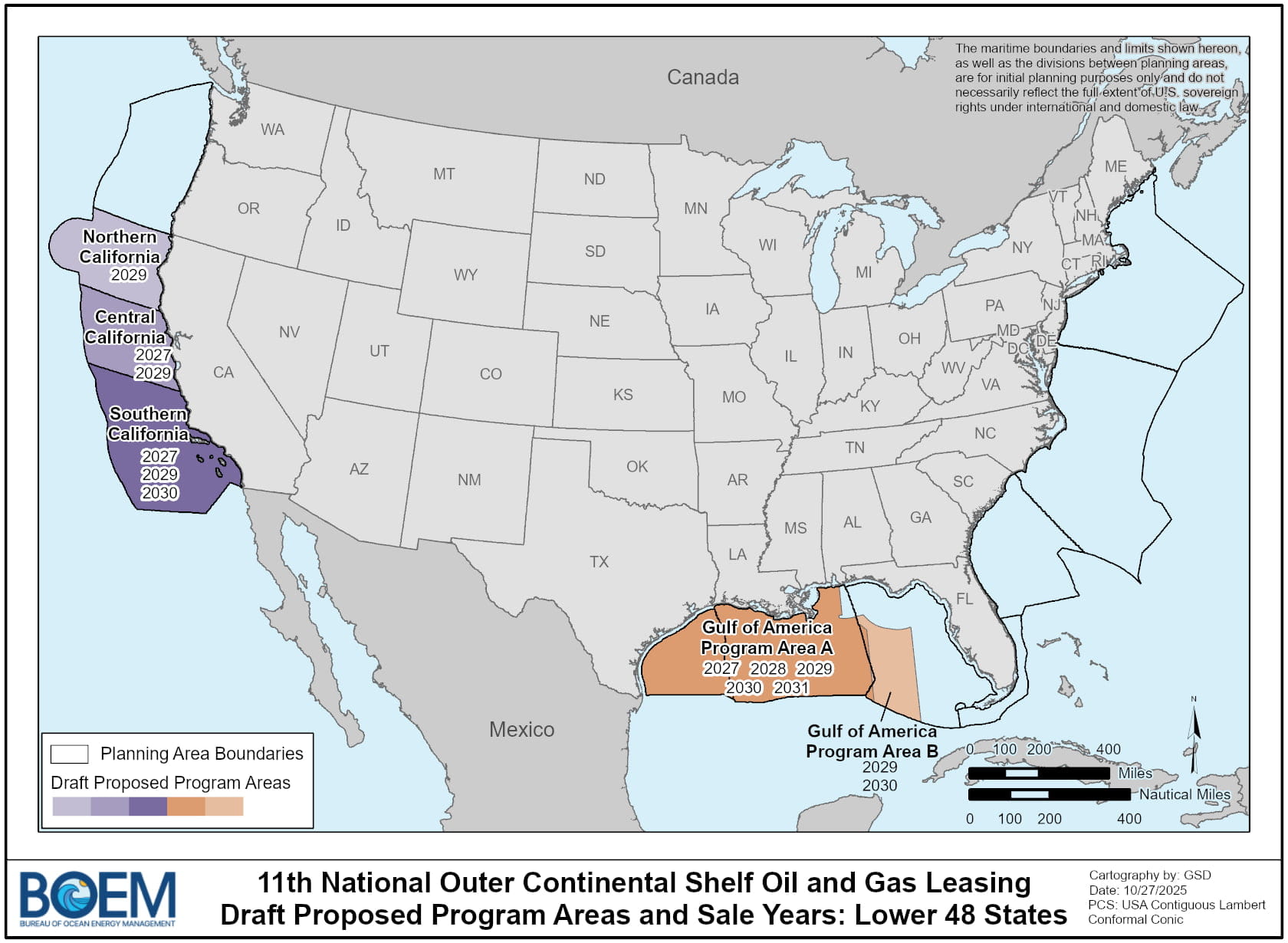
This poses a unique challenge for Eureka. Because it sits in an earthquake zone, a major seismic event and the resulting tsunami could damage an oil rig and trigger an enormous spill. That could decimate its thriving oyster industry and destroy businesses and homes.
“We are overdue for a massive earthquake, so we are very mindful of the risk inherent in drilling off our coast,” says Council Member Scott Bauer.
In May, the Eureka city council unanimously approved a resolution opposing offshore drilling. As much of the coastline is zoned industrial, it is theoretically easier for oil companies to build onshore facilities to serve oil rigs than if the city were zoned for tourism.

The statewide impact
Encinitas Mayor Bruce Ehlers says that his beach city has been preparing for this moment for decades. Almost 40 years ago, it wrote into its general plan a policy prohibiting companies from constructing oil drilling support facilities.
“Our beach is a regional resource, and it impacts the regional economy,” says Ehlers, who remembers using lighter fluid to dissolve tar and oil balls off the soles of his feet after a day at the beach. “It’s not just our residents who come to see our amazing sunsets. Tourists drive here for the beach and also contribute [to] the regional economy by visiting other attractions in San Diego County.”
Coastal cities are encouraging inland cities to take a stand. Actions can include drafting resolutions and ordinances, signing letters, and providing public comments on the draft federal plan. Santa Cruz’s Kalantari-Johnson says cities need to make a stand now to protect themselves in case this goes to court.

“Realistically, local jurisdictions can’t force [the] federal government to withdraw the proposal,” she says. “But they can control their own land: We are preparing for a potential legal battle by making sure that … if and when a company tries to move in, we have a legally sound mechanism in place so the federal government cannot preempt local ordinances around land use.”
Save Our Shores Director Thompson encourages cities to protect themselves now, while thinking about how to wean off fossil fuels and develop energy alternatives.
“It’s very distracting when we have to shift all of our resources to fight an industry that’s outdated,” she says. “That detracts from what we should be doing, which is exploring and improving other sources of cleaner energy.”
In the end, says Parry, Santa Monica’s chief sustainability officer, California’s coast is a beloved and valuable resource for the entire state: Every city has a stake in this fight.
“Protecting California’s signature ecosystems has environmental and economic benefits, not only for an individual city or county, but for the state as a whole,” Parry says. “The quality of our mountains, the qualities of our deserts, and the quality of our coasts and waters are key elements of the ecology and economy that support California. So even if you are not a coastal city, getting active around this issue is really important for us all.”