

CARE Court isn’t working as expected. What can cities do to strengthen it?
Dr. Aaron Meyer is an associate clinical professor of psychiatry at the University of California, San Diego, and the behavioral health officer for the city of San Diego. He can be reached at aameyer@sandiego.gov. Ann Marie Council is a retired senior deputy city attorney who advises municipalities and state policymakers on mental health law and emergency response systems. She can be reached at amc@quarterturnstrategies.com.
When CARE Court launched in 2023 through the passage of the CARE Act, many first responders and families welcomed its arrival. However, convincing people with untreated psychotic disorders to voluntarily accept treatment and court oversight is no easy task. While someone can be introduced to CARE Court involuntarily, participation is voluntary and court compliance is not forced.
Some critics argue that CARE Court needs expansion and more accountability, while others say it is too costly and coercive. State leaders have improved the CARE Act every year in part to address these concerns. Yet the challenges facing cities and patients alike remain the same: People with severe mental illness are repeatedly cycling through city emergency medical services (EMS) without a sustained improvement in care. This is in part because California lacks an effective system to manage the ongoing needs of patients with severe mental health disorders due to a shortage of available treatment beds.
Despite being some of the program’s largest interested parties and stakeholders, cities must rely on counties to administer the CARE Court program. So, who is the program not reaching? And how can cities strengthen it?
How does CARE Court work?
CARE Court is a statewide, court-supervised treatment program for people suffering from untreated psychotic disorders. Eligibility is limited to adults with diagnoses like schizophrenia or bipolar I disorder with psychotic features. To qualify, the individual must need court oversight of their treatment, often because previous attempts with other community mental health programs have been unsuccessful.
Eligibility is narrow by design to prioritize reaching individuals with the most severe mental health needs. Families, city first responders, and others can apply by filing a petition with their local mental health courts. This can be done with or without the approval of the potential participant. The person applying is the “petitioner,” and the person believed to need CARE Court oversight is the “respondent.”
The court and the CARE Court behavioral health team are both involved in efforts to engage the respondent. To learn about the practical process for submitting a CARE Court petition in your area, check your county’s superior court website.
Who are cities referring to CARE Court?
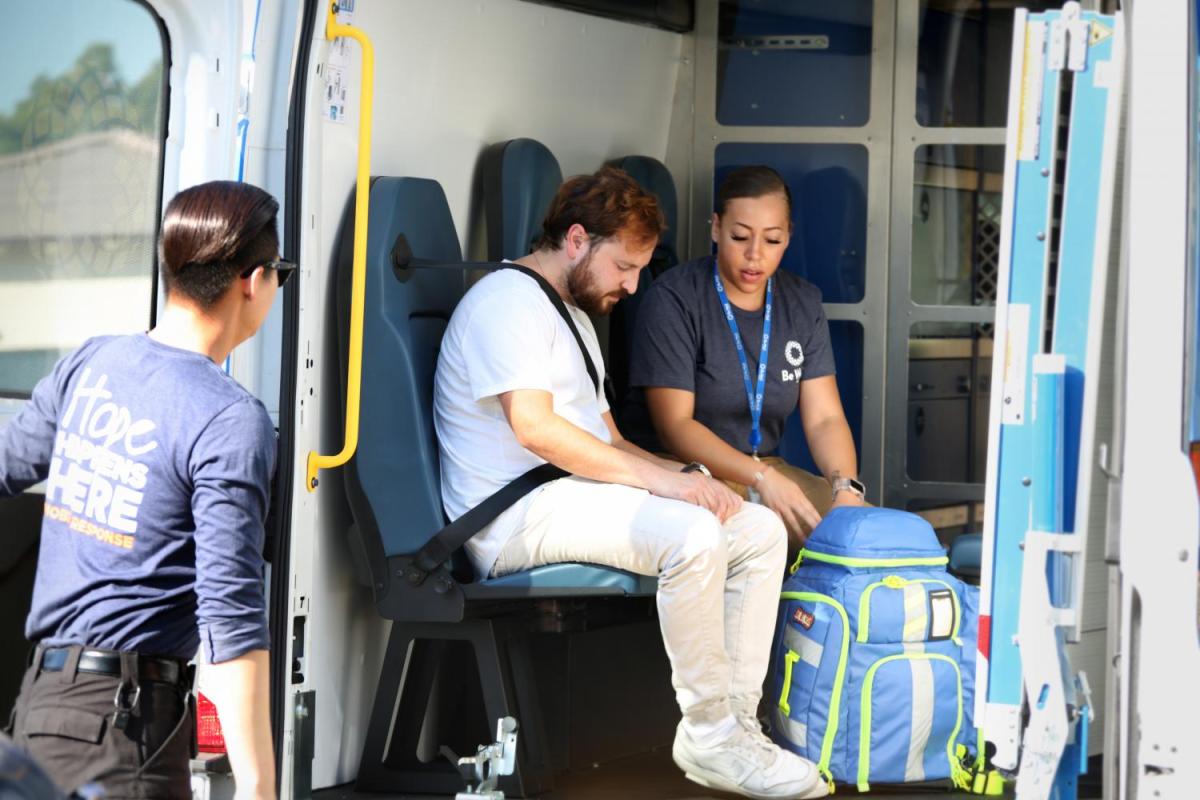
City first responders, especially in cities with street medicine, homeless outreach, or community paramedicine teams, are continually trying to connect individuals suffering from severe mental illness with effective treatment. These individuals can call 911 hundreds of times a year due to their inability to manage their basic needs.
First responders often take time to build rapport and encourage participation in programs that can improve a person’s quality of life. In addition to providing quality patient care, these programs can significantly reduce a person’s reliance on emergency services. Despite these efforts, many referrals to non-court treatment programs close quickly because either the county clinician is unable to contact the person, or the person is unable or unwilling to engage.
What does the CARE process look like?
While the court assists and oversees the process, the county behavioral health department is responsible for providing treatment. To ensure their due process rights are protected, each respondent receives legal representation.
After the court reviews the application and the county conducts outreach, the court holds the initial hearing. If accepted into the program, the county behavioral health department contracts with service providers to provide care to the respondent. CARE Court can order medications, treatment, and housing, but the respondent is never forced to comply.
CARE petitions are the only filings that city first responders can make directly to a mental health court. All other requests for mental health services are made to county programs outside the court system. After the city files a CARE petition, its participation is limited to the first hearing. If the respondent is accepted into the program, the petitioner is removed, and the county behavioral health department takes over as petitioner.

How is the program falling short?
The ironic truth is that the more severe a person’s mental health disorder, the less likely it is that they can accept treatment voluntarily. CARE Court is limited to those with psychosis; research shows that 27-57% of people diagnosed with schizophrenia “have severe unawareness of specific symptoms.” If CARE Court dismisses a petition due to lack of engagement or lack of insight into their illness, this can leave the respondent in the same situation they were in before the petition: cycling between the streets, EMS, and jails without the mental health care they need. After a petition dismissal, all patient information attesting to the need for help goes unused due to the CARE Act’s restrictive privacy provisions.
If CARE Court is unable to engage the respondent due to a severe mental health disorder, a petitioner may consider requesting an involuntary mental health hold or 5150 hold. These holds are time-limited hospital placements that facilitate mental health assessments, mental health evaluations, or crisis stabilizations. A 5150 hold can be sought for someone unable to meet their basic needs due to a mental illness or severe substance use problem. During this hold, the only state requirement is that an assessment is provided. A mental health evaluation is not mandatory; many 5150 holds end without connection to any new services.
During an assessment, authorized hospital staff determine whether an evaluation will be provided. In contrast, an evaluation requires that behavioral health professionals conduct “multidisciplinary professional analyses of a person’s medical, psychological, educational, social, financial, and legal conditions as may appear to constitute a problem.” The 5150 evaluation is more robust than a 5150 assessment.
CARE Court petitions are often filed after the 5150 hold process has failed to produce help. Since these holds are generally a moment-in-time assessment for acute danger, rather than a review of an ongoing crisis, a person in chronic crisis may never receive the treatment they need. CARE Court can be the longer-term intervention a person needs to enter treatment when the typical 5150 hold process does not lead to stabilization. The problem for cities, as well as the people in need of care, is that sometimes neither 5150 holds nor CARE Court can help chronically ill people who need treatment the most.
The CARE Act does not reference 5150 holds. However, it does offer an option for when the CARE Court program is insufficient, and the respondent’s safety is at risk. CARE Court can order a mental health evaluation. While this is the same evaluation sometimes available through a 5150 hold, this is a court order for the evaluation pursuant to Welfare and Institutions Code Section 5200. This evaluation can provide a big picture approach. While this option is included for court consideration when the respondent is terminated from the program, some have argued that these orders should be considered even while respondents are participating in CARE Court.
Counties rely on 5150 holds and do not have policies for submitting 5200 petitions for court-ordered evaluations. Without the use of 5200 court-ordered mental health evaluations and the limitations of 5150 hold assessments, many people with the most severe needs can remain untreated. This gap is inconsistent with the CARE Act’s intent.
What happens to a respondent after a CARE Act Petition is dismissed?
Cities need court assistance to help people with severe mental illness who are cycling through the city’s EMS systems. However, their illnesses are often too severe for the current CARE Court model. When courts dismiss cases without any referral to a higher level of care, the system’s non-use of 5200 court-ordered mental health evaluations should give cities pause.
The CARE Court reviews all submitted petitions for eligibility. Some petitions are dismissed at or before the first hearing. Although some early data from counties measure dismissal rates, rates for first responder petitions are not specifically measured. Of the 160 cases dismissed in the first nine months of this program statewide, 70 respondents received some form of county behavioral health services. The other 90 respondents received none.
In Los Angeles County, data from the first year and a half of implementation shows that 29 of the first 130 dismissals were dismissed because the respondent needed a “higher level of care” than CARE Court could offer. Families have expressed similar concerns and frustrations.
How can cities improve CARE Court’s effectiveness?
Even though cities are official stakeholders in CARE Court and often have a front row seat to a person’s deterioration, their inclusion in eligibility and treatment decisions is limited. However, cities can collaborate with counties in CARE Court’s continued development. There are several solutions that cities can advocate for as official stakeholders that could close treatment gaps for those diagnosed with the most severe mental health disorders. Cities can request that:
- CARE teams consider the high use of 911 services as strong evidence of instability, coupled with unmanaged mental health disorders.
- Counties report on the number of respondents who required conservatorship or criminal justice intervention within 12 months of case dismissal.
- Counties adopt written policies and processes for the use of 5200 court-ordered mental health evaluations when the respondent’s safety is at risk.
Prioritization of those with the most severe mental health disorders will require continued advocacy by city leadership at the state and local levels to ensure that services are preferentially directed to people who are seen the most yet treated the least.
For a more detailed discussion of this topic, see “CARE Court: Can Cities Make it Work?”