

High-quality childcare is scarce and expensive. Can cities change that?
Jackie Krentzman is a Bay Area-based writer and editor.
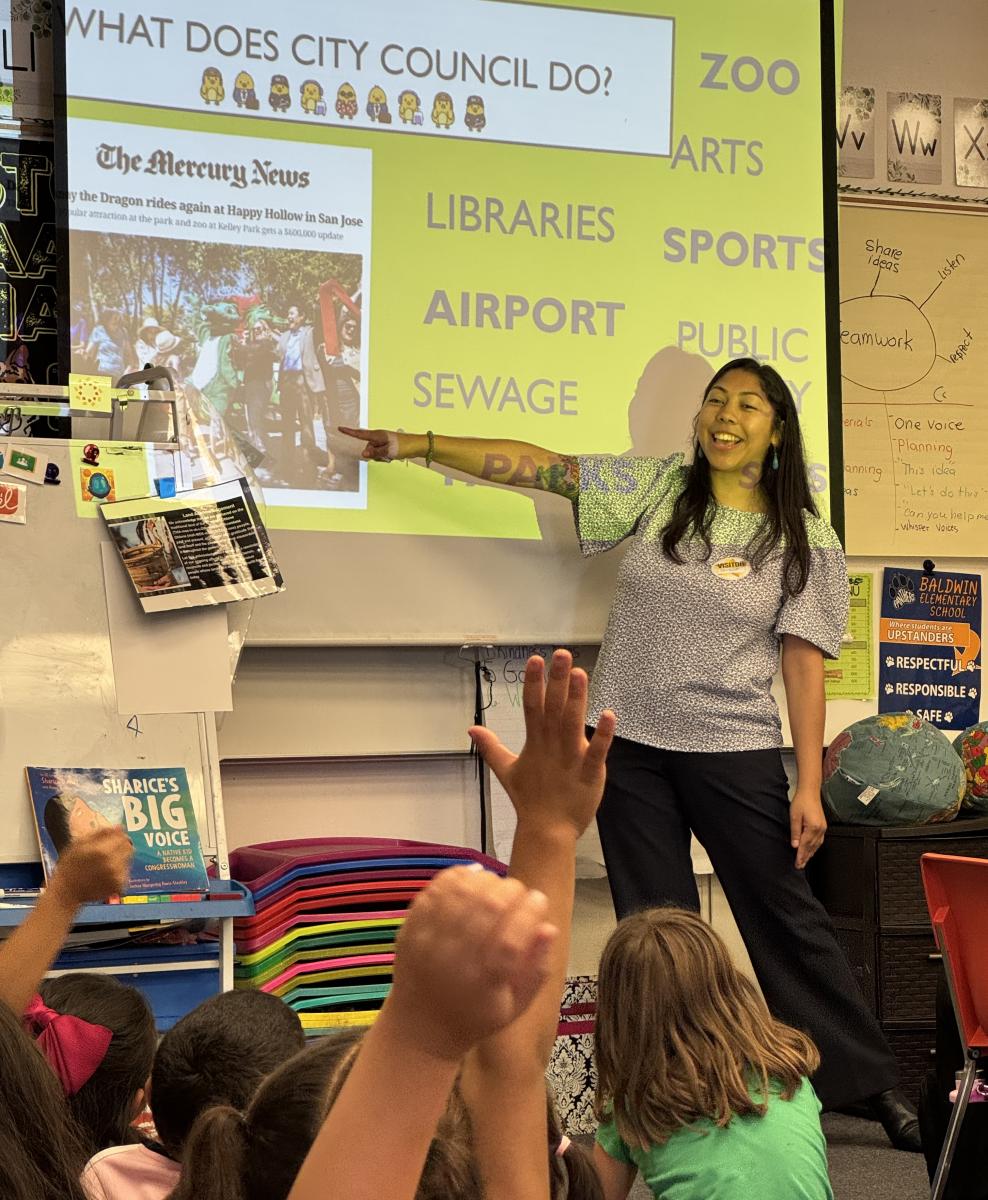
Pamela Campos was eager to start her first job as a preschool teacher. But when she realized that even with a bachelor’s degree in child and adolescent development, she was not going to earn more than $17 an hour, she changed fields, moving into policy.
Her story is not unique.
“Today, you have so many young people in my position who saw early learning and childcare as their calling but realized it was a career dead end,” Campos, now a San José council member, says. “You can be a dog walker; you could work at a local coffee shop and earn more than the people who are shaping our children and future leaders.”
In California, finding good, affordable childcare can be a fraught experience due largely to the high cost of living and a shortage of qualified, well-paid childcare employees. The state has recognized the challenge. In 2021, California committed to adding over 200,000 new subsidized childcare spaces over several years. So far, it has added nearly 130,000 spaces and universal transitional kindergarten. Still, many parents cannot afford to place young children in childcare or early learning.
“This puts real pressure on families,” says Caroline Danielson, a co-author of a Public Policy Institute of California (PPIC) study, Experts Talk Cost And Supply in California’s Childcare. “If you are not eligible for the subsidies (or are put on a subsidy waiting list) you may not be able to afford a spot — in which case you have to pay the private pay rate or care for your children yourself, which means potentially cutting back on your employment.”
Childcare expenses compound with the high cost of living
Experts repeatedly cite the high cost of living as the biggest barrier to affordable childcare in California. Families spend such a high percentage of their income on housing, food, and healthcare that there often isn’t enough left over to pay for quality childcare. This has families moving out of state or to less expensive regions.
“The average median income in San José is about $140,000, but the minimum wage is $17.95,” says Campos, who estimates that roughly one-third of families in the city cannot afford childcare. “A single person at that hourly wage would need to work three full-time jobs just to afford a one-bedroom apartment here. And so, when you put that in perspective for a family of four, it is grossly unachievable to live a healthy quality of life in San José, especially when you factor in the cost of childcare.”
Lakewood Mayor Cassandra Chase says that the affordability gap is reaching a crisis stage, especially for mothers, who often bear the burden of caring for a child.
“As a woman leader, it’s been near and dear to my heart seeing some of the challenges that folks encounter — having to choose between pursuing a career or pursuing leadership or being forced to stay at home to be able to provide the care that their children need,” she says.
Childcare is expensive and wages are low
According to the PPIC report, the median annual cost of full-time childcare for a preschool-age child (ages two to four) ranges between $9,000 and $24,000. For an infant (under two), it ranges between $11,000 and $29,000 — about 6% to 28% of the state’s median income.
Local agencies that connect families to childcare indicated that only a third of families in the state could find affordable care for infants. That number increased to 56% for toddlers and 77% for preschoolers.
Overall, the number of slots for childcare has increased since 2015 as the state’s population declined and universal transitional kindergarten kicked in. However, the availability of licensed childcare spots varies greatly by region and income: Most of the capacity gains have been in higher income regions.
“Quality childcare is expensive for providers to operate because of the costs of staffing, licensing, and facilities,” Carlsbad Council Member Priya Bhat-Patel says. “As a result, we are seeing a persistent shortage of high-quality licensed facilities.”
So, while capacity has increased statewide, that doesn’t necessarily mean there are enough spaces. Many centers are having a hard time finding and retaining staff because of low salaries. In the first quarter of 2023, childcare workers earned about $18 an hour. Preschool teachers earned $19.50 an hour on average. Roughly half of households led by childcare workers participated in one or more safety net programs, leading to an outflux from the profession.

What can cities do?
Most cities are not in the business of subsidizing childcare. But cities may want to reconsider that, as boosting access can benefit both families and the overall economy.
“In my career, I have heard so many times that childcare is not the business of the city,” says Campos. “However, childcare is absolutely part of economic development. We need people to be able to show up and go to work and do their jobs, which they can’t do if they are caring for their children.”
According to Campos, childcare and early learning help prepare kids academically and socially. They teach basic skills that are crucial to future success, like waiting or sharing. “The first five years is where 95% of the brain develops,” she says, “Anyone who interacts with a child regularly in those years is a brain architect, and positive social and learning experiences will carry these young children through the rest of their lives.”
Even cities that do not fund childcare can increase access by smoothing the permitting process and fee schedule for childcare operators. In 2019, the state passed SB 234 (Skinner), removing licensing barriers and eliminating or reducing fees for providers.
“Cities can pass similar laws,” says Campos. “We want to send the message that you have every right to run a childcare center with no red tape, aside from the state licensing standards. Cities should not add layers of complexity onto that.”
As making on-the-ground changes can take time, some cities, including San José and West Hollywood, have passed resolutions announcing their commitment to supporting affordable childcare.
“We wanted to elevate the issue,” says West Hollywood Mayor Chelsea Byers. “Families were raising childcare as a concern, and in order to help lay the groundwork for that conversation — and the sort of long-term work that the city would need to commit to — we put out a resolution identifying this as a critical need, acknowledging we were listening to the community and its concerns.”

Changing the built environment
Most California cities were built during the heyday of single-family homes and automobiles. Today, with concerns over skyrocketing housing costs, traffic-clogged commutes, and climate change mounting, many cities are rethinking the built environment, advocating for constructing both housing and childcare facilities near transit hubs.
“It is essential that we try to co-locate childcare facilities in affordable housing developments,” says Campos. “It is so logical to make sure that the childcare parents need is in walking distance.”
She points to a new affordable housing complex with a childcare center on the ground floor in San José at the Tamien Light Rail Station. “That is the model that we want to see replicated throughout the transit hubs of San José,” she says.
But boosting the infrastructure extends beyond new childcare facilities. In recent years, Carlsbad has prioritized making its built environment family-friendly. In 2021, it launched Safe Route to School, adding new walking and biking access and traffic calming measures. West Hollywood is looking into a variety of potential fixes, from adding more lighting to streets to adding new protected bike lanes.
Family-friendly policies go well beyond childcare and early education access. Carlsbad’s Bhat-Patel advocates for adding diaper changing tables in both men’s and women’s restrooms and expanding family leave policies for new parents, including those who have adopted children.

For a number of city officials, bringing about affordable, high-quality childcare and related amenities is personal. Bhat-Patel had her first child while on the council. (She attended a council meeting virtually when she was in the hospital giving birth.) She says that investing in childcare — and keeping it on the front burner as an issue — is investing in the future.
“I believe strongly in the importance of representation — having working moms at the decision-making table ensures that the policies we create reflect the realities families face every day,” she says. “For many parents, the cost of childcare is overwhelming, the support networks are limited, and flexibility is scarce. By sharing my own experiences openly, I hope to not only normalize the presence of working moms in leadership roles but also push for structural changes that make family and childcare support more accessible.”
In the end, Bhat-Patel and Lakewood’s Chase emphasize that advocating for affordable, quality childcare and early learning should not be siloed as a so-called “women’s issue.”
“When we invest in childcare, we ultimately invest in women,” Chase says. “When we invest in women, we invest in families, and when we invest in families, then we’re creating stronger communities and stronger cities. It is a win-win for everyone.”